
I Think of You Constantly with Love. The Letters of Ludwig Wittgenstein and Ben Richards. INTERVIEW WITH ALFRED SCHMIDT
I Think of You Constantly with Love
The Letters of Ludwig Wittgenstein and Ben Richards
Ed. by Gabriel Citron & Alfred Schmidt
London: Bloomsbury 2026
ISBN: 9781350026469
Publishing date: April 16, 2026
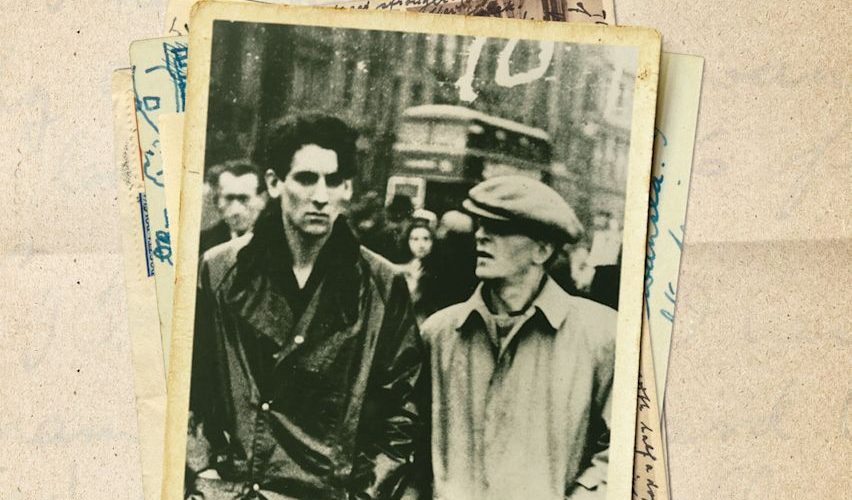
Ludwig Wittgenstein and Ben Richards met in the autumn of 1945, when Richards – a medical student – was attending one of Wittgenstein’s courses. The ‘loving friendship’ (in Wittgenstein’s words) which subsequently developed between them decisively coloured every aspect of Wittgenstein’s last years.
INTERVIEW WITH ALFRED SCHMIDT
 Wittgenstein Initiative: What makes this correspondence of Wittgenstein so special?
Alfred Schmidt: The correspondence between Ludwig Wittgenstein and Ben Richards, a medical student some 35 years his junior, now published in the original English, is the most extensive and arguably also the most personal and intimate of Ludwig Wittgenstein’s known correspondence. In numerous letters, Wittgenstein encloses dried flowers, a romantic gesture not found in his correspondence with any other correspondent.
It is no exaggeration to say that this is the last major, hitherto completely unknown collection of original documents relating to Wittgenstein. Richards was Wittgenstein’s great love during the last six years of his life; the letters paint a touching picture of this passionate relationship.
W.I.: Why is the correspondence only being published now?
A.S.: The entire correspondence, which comprises 373 items, came to the Austrian National Library in two stages: an initial collection of 150 letters, all from Ludwig Wittgenstein to Richards, was acquired from his widow Tara, shortly after Richards’ death in 1995, though on the condition that the letters would remain closed to any use until 2020. It was only during the editing of these letters that another 220 letters came to light in the possession of Richards’ daughter Miranda, including many replies from her father, though these are considerably fewer in number. In 2021, the Austrian National Library was able to acquire this second part of the correspondence as well.
W.I.: What are the main themes of the correspondence?
A.S.: Primarily, everyday matters: travelogues, arranging meetings, advice on Richard’s education; Wittgenstein describes his observations of nature in Ireland and during his stay with Norman Malcolm in the USA, whilst Richard writes about his studies and work placements in various hospitals, or his holiday in Italy, and so on. A recurring theme is also their shared enthusiasm for music; they listen to music together, Wittgenstein tries to get Richards interested in Anton Bruckner …, they discuss their reading, and Wittgenstein also reports sporadically on his lectures or the meetings at the Moral Science Club in Cambridge and the like.
The actual, recurring theme of the letters, however, are Wittgenstein’s feelings towards Richards, his great love, his dependence on Richards’ affection, and his constant fears and doubts about this relationship.
W.I.: Does this correspondence alter our view of Wittgenstein’s personality?
A.S.: The correspondence provides a detailed picture of Wittgenstein’s final years from 1946 onwards, including previously unknown details: one example is Anscombe’s account of her legendary encounter with C.S. Lewis at the Socratic Club in Oxford on 2 February 1948, which Wittgenstein enclosed to his letter to Richards dated 11 February 1948. Wittgenstein’s final period in Cambridge until he resigned from his chair at the end of 1947, his subsequent extended stays in Ireland, his trip to the United States to visit Norman Malcolm in the summer of 1949, his regular stays with his family in Vienna and in Swansea, his final trip with Richards to Skjolden, Norway, in the autumn of 1950: we learn many previously unknown details about all these stages of his life.
Wittgenstein’s tone in the letters to Richards is very open; it paints a vivid, deeply intimate picture of his profound insecurity and anxiety about loss, but also of his happiness during his many meetings with his friend. We must revise our image of Wittgenstein’s final years as that of a solitary philosopher wholly devoted to his magnum opus – the Philosophical Investigations. We see that Ben Richards was the true centre of his life during these final years, and that he was fully aware of this dependence, particularly in his ability to engage in philosophical work. He sums this up in a touching letter written on 11 April 1951, just a few days before his death:
“Here is one thing I want to tell you. Whatever happens to me now, I want you to know that you have given me more than I could possibly ever have hoped for. You have given me happiness & joy which I never deserved & made my life different altogether from what it would have been without you. Thanks for all you did for me. /You are at the heart of all my happiness./”
W.I.: What picture and what impressions of post-war Vienna emerge from this correspondence?
A.S.: Wittgenstein remained in close contact with his family also in the period after the Second World War. Every year, he spent several weeks in Vienna: in September 1947, September 1948, April/May 1949, and one last time from December 1949 to March 1950, when his sister Hermine lay dying. Wittgenstein’s impressions of occupied post-war Vienna are gloomy. He is surprised that, despite all the misery, one can still listen to good music here (letter of 13 September 1947). During his first stay in the autumn of 1947, he stayed with his niece Marie Stockert, as the family mansion on Argentinierstraße is still uninhabitable due to war damage. Wittgenstein is devastated by his sister Mining’s (Hermine) illness and spends much of his time at her bedside. He recounts the domestic music-making sessions organised by his sister Helene together with his friend Rudolf Koder…
W.I.: Wittgenstein’s Austrian background and his culture – to what extent are these reflected in this correspondence?
A.S.: Wittgenstein’s deep roots in 19th-century culture, and specifically in fin-de-siècle Vienna, have been widely recognised since Janik and Toulmin’s well-known study “Wittgenstein’s Vienna”.
In his correspondence with Ben Richards, many of Wittgenstein’s particular preferences emerge, which we also recognise from other contexts: for instance, his enthusiasm for Tolstoy, for Goethe’s Theory of Colours, Wilhelm Busch, or even Peter Cheyne’s detective novels.
He particularly cherishes, for instance, the motto of Robert Schumann’s ‘Davidsbündler-Tänze’ and returns to it repeatedly:
In all und jeder Zeit
Verknüpft sich Lust und Leid:
Bleibt fromm in Lust und seyd
Dem Leid mit Muth bereit.
(In all and every time
Joy and sorrow are intertwined:
Remain devout in joy and be
Ready to face sorrow with courage.)
It expressed his own outlook on life in the most concise form.
Wittgenstein’s deep and refined understanding of music also runs through many of the letters as a recurring theme. He enthusiastically reports to Richards about Otto Böhler’s silhouettes on the cover of Alma Mahler’s biography of Gustav Mahler, which depict the conductor in characteristic poses. In Richards, he finds a conversation partner who is equally passionate about music.
order from